
Paint peeling off a wall is easy to blame on the paint. On a hot, dry site, the paint is often the last thing to fail. The wall heats up, cools down, takes in moisture and pushes salts to the surface — and the film has to survive all of it.
Here is what usually goes wrong on sun-exposed facades, how to tell which problem you are looking at, and what to put on the wall so the next coat lasts.
What the sun and the wall do to a coating
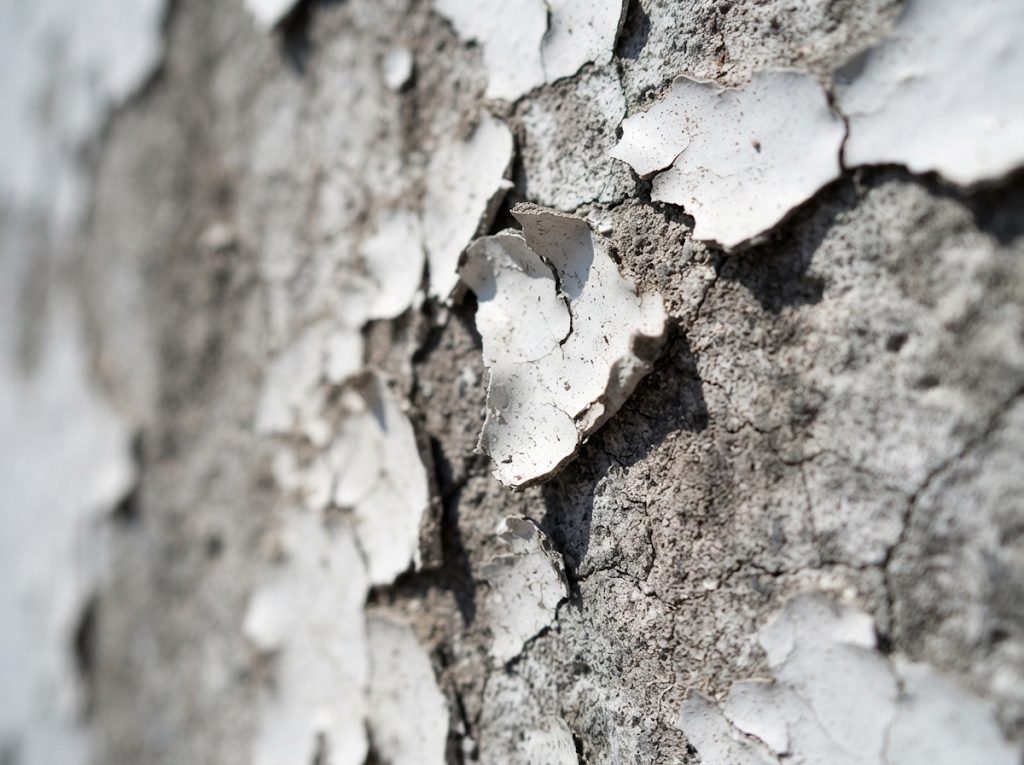
Peeling is a failure of grip, not a colour problem. On a dry, hot site, several things usually happen at once.
Sunlight breaks down the binder
Strong UV doesn’t just fade the colour. It attacks the resin that holds the film together. First the surface goes chalky — rub it and a white powder comes off. Then the film hardens and loses its stretch. Once it can’t move with the wall, small cracks open and the edges start to lift.
The wall moves more than you think
Concrete and render expand in the afternoon sun and contract at night. A dark facade can be much hotter than the air around it. The paint film and the wall don’t move at the same rate, and the difference shows up at the bond line. That is why failures often start at corners, window reveals and the south or west face.
Moisture comes from behind
Even in dry regions, walls hold water. Bathrooms, kitchens, leaking pipes, irrigation and rising damp all put moisture into the render. At night the wall cools, vapour forms behind the film and pushes outward. First you see blisters; later the film comes off in sheets.
Alkaline concrete and salts
New concrete and cement render are alkaline. Fresh render can be strongly alkaline, and ordinary paint doesn’t like it — the binder softens and loses grip. Soluble salts add a second problem: water carries them to the surface, they crystallise under the paint and lift it. White powder on the wall is a warning, not just a cosmetic issue.
Dust and site dirt
On a dry site, dust gets into everything. If it isn’t cleaned off before priming, the primer sticks to the dust, not the wall. Wind-blown sand also wears the film down. Release agents left on new concrete can act like a layer of grease.
Reading the failure pattern
Where and how the paint comes off tells you a lot about the cause. Look at the pattern before you choose a repair.
| What you see | What it usually means | What to do |
|---|---|---|
| Sheets peel back to bare concrete | Dust, oil or a damp wall before painting | Strip the loose film, clean, check moisture, prime |
| Blisters that burst and peel | Moisture behind the film | Find the water source; use a coating that lets vapour escape |
| Edges and corners lift | Thin film or missed primer at cut-ins | Re-coat to full thickness, including edges |
| Chalky surface, then peeling | UV damage or a cheap exterior binder | Remove the chalk, use a UV-stable acrylic |
| Peeling over an older coat | Incompatible coats or poor inter-coat grip | Test adhesion, use a bonding primer |
Check the wall before you buy paint
Repainting a failed wall without finding the cause wastes a season. These simple checks work on site and need no special equipment.
Tape test
Score a small grid through the coating with a knife, press tape over it and pull it off. If more than a little paint lifts, the old film is not sound and has to come off. Test a few areas that look fine as well — weak spots are often wider than the visible peeling.
Plastic sheet test
Tape a clear plastic sheet to the wall and leave it for a day. If water collects underneath, the wall is giving off moisture. Don’t paint until you find where the water is coming from: a leaking pipe, a roof detail, drainage or rising damp.
pH check
Dampen a small patch and press a pH strip against it. A high reading means the render is still alkaline. New render needs time to cure; in hot weather the surface dries quickly but the wall stays alkaline for longer.
Salts and white powder
Brush off white deposits and see whether they come back. If they do, water is still moving through the wall. Washing the surface and painting over it won’t stop that.
Preparation that gives the paint a chance
Most early failures are decided before the first coat goes on.
- Take off everything loose. Scrape, grind or wash off flaking paint. Feather the edges of sound paint so the repair doesn’t leave a step.
- Repair the wall. Cut out and fill cracks, hollow render and damaged areas with a compatible repair mortar. Let it cure.
- Clean the surface. Remove dust, oil, grease and algae. On a dry site, dust is the most common reason a primer fails — brush and vacuum rather than blowing it around.
- Check moisture and pH again. Cleaning can change both. Don’t prime until the wall is within the limits given by the coating supplier.
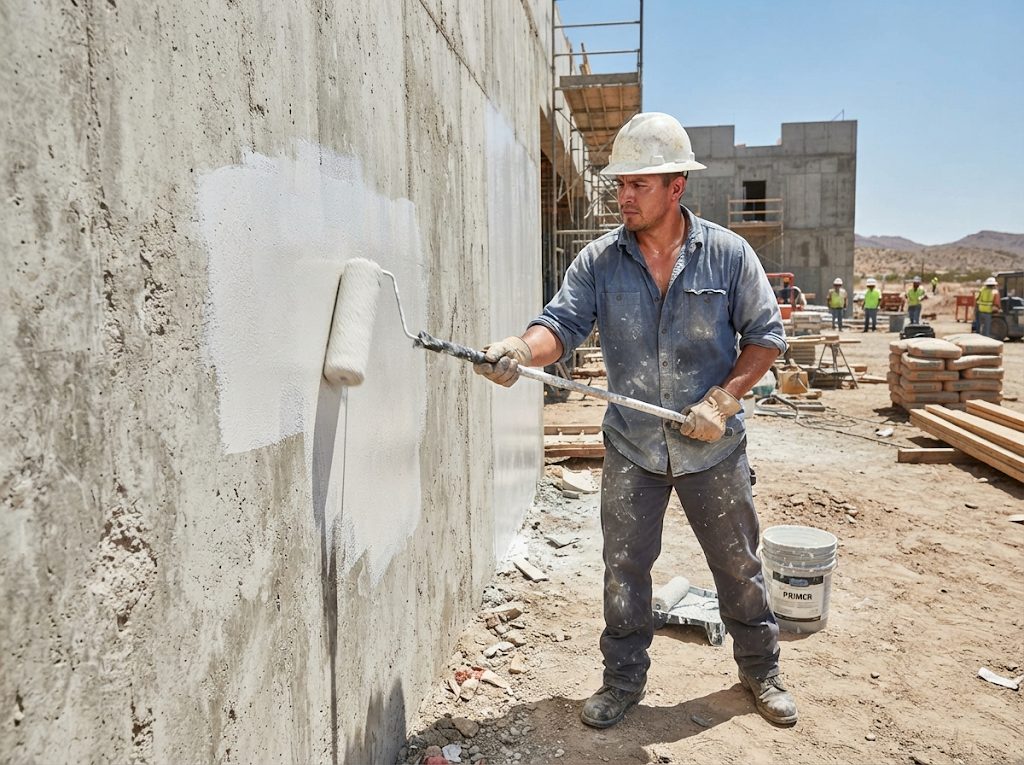
- Prime the whole elevation. Use an alkali-resistant primer on concrete and render, and a bonding primer on sound but glossy or previously painted surfaces. Don’t water it down.
- Don’t leave primer exposed. Finish within the recoat time given on the product. Primer left in the sun and dust for weeks is not the same as a fresh primer.
Choosing a coating that suits a hot, dry site
Look at the binder, not just the label
Exterior paints are built on different resins. A pure acrylic binder usually holds up best in strong sun: it keeps its flexibility longer and resists alkaline walls. Styrene-acrylic can work on sheltered walls where cost matters, but it tends to chalk faster. Vinyl-acetate paints belong indoors.
When an elastic coating makes sense
Elastic coatings can stretch over small cracks and handle movement. They help on large facades and repair work, but they won’t fix a crack that is still moving. Repair the wall first, then choose the coating.
Stone and textured finishes
Real stone paint, water-in-sand and water-in-water finishes give a heavier, textured surface and better UV protection. They also hide small imperfections. The catch is that a heavy finish needs a solid base — if the primer is weak, the textured coat will fail faster than a flat paint. Build a sample panel before the full job.
Colour matters more than people think
Light colours stay cooler. A dark wall can be significantly hotter than a white one, which speeds up ageing and movement. If the design calls for dark tones, use a better binder on those areas.
| Substrate or condition | Recommended system | Notes |
|---|---|---|
| New concrete or render, cured | Alkali-resistant primer + pure acrylic exterior paint | Check pH and moisture; two finish coats |
| Small cracks in sound render | Elastic primer + elastic topcoat | Repair cracks wider than the coating can bridge |
| Sound, previously painted wall | Bonding primer + acrylic topcoat | Test adhesion first; check compatibility |
| Premium residential facade | Primer + real stone paint or water-in-sand | Sample panel; keep the film build |
| Wall with recurring white salts | Fix the water path, then a breathable alkali-resistant system | Don’t seal the salts in |
Application habits that make a difference
- Don’t paint a wall that’s too hot to touch. Work early in the morning or shade the elevation. Most coatings have a surface-temperature limit in their data sheet.
- Follow the recoat time. Too early and you trap solvent or water; too late and the next coat may not bond.
- Put on the thickness the product asks for. Two thin coats are not the same as two correct coats. Check coverage as you go.
- Don’t thin the paint to stretch it. More water means less binder and a thinner film — a common reason facades peel early.
- Watch the weather. Even in a dry climate, night dew and wind-blown dust can damage a fresh film.
- Check the job before the scaffold comes down. Look for misses, pinholes and thin edges. Small defects become peeling points after a season or two.
A simple checklist for contractors
- Choose the coating by binder and performance, not only by colour.
- Check adhesion, moisture, pH and salts on every elevation.
- Never paint over dust, oil or a damp wall.
- Use an alkali-resistant primer on concrete and render.
- Repair cracks and hollow render before coating.
- Use a pure acrylic for walls in strong sun.
- Keep the film thickness within the product’s range.
- Use light colours where the design allows.
- Build a sample panel for textured or stone finishes.
- Plan an inspection every few years, not only when the paint fails.
When the wall, not the paint, is the problem
Sometimes the coating is fine and the render is falling apart. Hollow render, structural cracks and long-term damp will pull any paint off. In that case, repair the wall first. A new topcoat over a failing substrate is a short-term fix that comes back to bite you.
FAQ
Can I just paint over peeling paint?
No. A new coat can’t re-bond a failed film. Remove the loose paint, repair the wall and prime before repainting. Painting over it traps the failure and shortens the life of the new coat.
What is the best paint for a hot, dry climate?
A pure acrylic exterior paint with good UV and alkali resistance is the usual choice. If the wall has small moving cracks, an elastic acrylic may suit better. The primer and the preparation matter as much as the topcoat.
Why does the paint peel in patches?
Patches usually point to local conditions: dust or oil on part of the wall, a damp spot, alkaline render, or an area that was missed during priming. Map the patches against the elevation — the pattern often tells you the cause.
How long should exterior paint last?
It depends on the coating, the colour, the wall and the weather. A well-specified system on a sound, properly prepared wall can last many years, but UV and heat are hard on any film. Inspect every few years and plan a maintenance coat before the paint fails.
Is primer really necessary?
Yes. The primer is the bond between the wall and the finish. On concrete and render it also helps control alkalinity. Skipping it, or thinning it, is one of the most common reasons a facade peels within a few seasons.
Final word
Peeling is rarely one product’s fault. It is usually the result of a wall that wasn’t checked, a surface that wasn’t clean, or a coating that wasn’t given the right base. Get those three right and a facade in a hot, dry climate can hold its finish for years.
Five Lakes Coatings has made water-based coatings since 1984, including exterior wall emulsion paint, elastic textured latex paint, alkali-resistant sealing primer and real stone paint. If you are planning a facade for a hot, dry market, send us the project details or message us on WhatsApp (+86 15165999188). For stone finishes, see our comparison of real stone paint vs water-in-sand coating.