Exterior walls in Central Asia face more demanding environmental conditions than many ordinary building projects.
Kazakhstan, Uzbekistan, Kyrgyzstan, Tajikistan and Turkmenistan include extensive continental, arid and semi-arid areas. Depending on the project location, exterior façades may be exposed to strong sunlight, large seasonal temperature changes, dry winds, dust, snow, freezing conditions and occasional moisture penetration. Dust and sandstorms are also common in many arid and semi-arid parts of the region.
These conditions can cause premature cracking, fading, chalking, peeling and surface contamination when the wrong coating system is selected or the wall is not properly prepared.
Understanding the most common problems can help contractors, developers, distributors and building-material importers select a more reliable exterior wall coating system.
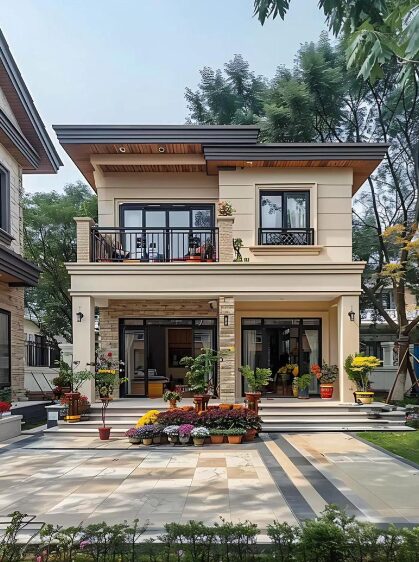
1. Cracking Caused by Temperature Changes
One of the most common exterior wall problems in Central Asia is cracking.
Buildings can experience significant changes between daytime and nighttime temperatures, as well as between hot summers and cold winters. The wall substrate repeatedly expands and contracts. When the coating is too rigid, applied too thickly or placed over untreated structural cracks, visible cracks may gradually appear.
Poor-quality putty, unstable cement substrates and insufficient curing can make the problem more serious.
Recommended solution
Before applying any exterior coating, contractors should inspect the substrate and repair existing cracks. Loose cement, dust and weak putty must be removed.
A complete coating system should normally include:
- Proper wall-surface preparation
- Crack repair and levelling
- An alkali-resistant exterior primer
- A compatible decorative coating
- A protective exterior topcoat when required
For projects requiring a textured stone appearance, real stone paint or water-in-sand coating can help cover minor surface irregularities. However, decorative coatings should never be used to hide active structural cracks. The underlying wall problem must be repaired first.
2. Fading and Chalking Under Strong Sunlight
Strong sunlight and ultraviolet exposure can gradually damage exterior coating colour.
Fading causes the original colour to become lighter or uneven. Chalking produces a powder-like layer on the surface of the coating. Low-quality paint, insufficient coating thickness, unsuitable pigments and prolonged sunlight exposure can all accelerate these problems. PPG and Sherwin-Williams both identify intense sunlight, low-grade coatings and insufficient film thickness as common causes of exterior fading and chalking.
This problem is especially noticeable on large commercial façades and residential developments because different elevations may receive different levels of sunlight.
Recommended solution
Projects should use exterior-grade coatings designed for weather and ultraviolet resistance.
The following measures can improve colour stability:
- Select high-quality exterior acrylic materials
- Use stable exterior-grade pigments
- Apply the recommended coating thickness
- Avoid excessive on-site dilution
- Use compatible primer, main coating and topcoat products
- Produce a sample panel before large-scale application
For high-end projects, water-in-water coating can create a marble-like appearance, while water-in-sand coating can produce a granite-like texture. A suitable protective topcoat can help improve stain resistance and maintain the decorative effect.
3. Peeling and Blistering Caused by Poor Adhesion
Peeling occurs when the coating loses adhesion to the wall. Blistering appears as bubbles or raised areas beneath the coating film.
These problems are often caused by moisture, dust, weak substrates, insufficient surface preparation or painting before the wall has dried completely. Painting directly over loose or peeling material will usually result in repeated coating failure. Sherwin-Williams recommends removing loose coatings, repairing damaged areas and priming the surface before repainting.
In dusty construction environments, even a thin layer of dust between the wall and primer can reduce adhesion.
Recommended solution
The substrate must be clean, stable and dry before coating application.
Contractors should:
- Remove loose paint, weak putty and surface dust.
- Repair holes, cracks and damaged cement.
- Check for water leakage or moisture penetration.
- Allow new cement or plaster to cure properly.
- Apply a suitable penetrating or alkali-resistant primer.
- Follow the recommended drying time between each coating layer.
For large construction projects, a small adhesion test area should be completed before full application.
4. Efflorescence and Alkali Discolouration
Efflorescence is a white, powdery or crystalline deposit that appears on masonry, brick or concrete surfaces.
It is usually created when moisture carries soluble salts through the wall. As the moisture evaporates, the salts remain on the surface. Painting directly over efflorescence can lead to discolouration, poor adhesion and peeling. Benjamin Moore recommends removing efflorescence before painting rather than covering it directly.
New cement walls may also have relatively high alkalinity. If an unsuitable coating is applied too early, the colour and coating film can be damaged.
Recommended solution
Before coating application:
- Identify and repair the source of moisture
- Remove visible salt deposits
- Allow the wall to dry thoroughly
- Confirm that new cement or plaster has cured
- Apply an alkali-resistant exterior primer
- Use a compatible and breathable exterior coating system
A complete system is usually more reliable than purchasing primer, putty and decorative coatings from unrelated suppliers without checking compatibility.
5. Dust Accumulation, Staining and Uneven Appearance
Dust is an important challenge for exterior walls in many Central Asian locations.
Textured coatings can create an attractive stone appearance, but an excessively rough or poorly protected surface may collect more dust. Uneven spraying, different material batches and inconsistent dilution can also create visible colour differences across a large façade.
The problem is not always caused by the coating itself. In many cases, it results from inconsistent construction methods.
Recommended solution
For dusty or high-traffic locations, the coating system should balance texture with cleanability.
Important measures include:
- Select a suitable texture for the local environment
- Use a stain-resistant protective topcoat when necessary
- Keep dilution ratios consistent
- Use materials from the same production batch on one elevation
- Maintain consistent spray pressure and application technique
- Complete a full sample panel before mass application
- Protect unfinished walls from dust during construction
Light and medium stone colours are often practical for dusty environments because minor surface dust may be less visible than on very dark or highly saturated colours.
Which Exterior Coating Is Suitable for Central Asian Projects?
Different buildings require different decorative effects, budgets and performance levels.
Real stone paint
Real stone paint provides a natural stone-like texture and is suitable for residential buildings, commercial façades, boundary walls and large construction projects.
Its main advantages include:
- Natural textured appearance
- Wide colour selection
- Lower façade weight than natural stone
- Suitable for large-area application
- Competitive project cost
Water-in-sand coating
Water-in-sand coating creates a granite-like decorative appearance with multiple colours and particles.
It is suitable for:
- Villas
- Hotels
- Apartment buildings
- Commercial complexes
- High-end residential projects
It can provide a more layered stone effect while reducing the weight and installation complexity associated with natural granite.
Water-in-water coating
Water-in-water coating is mainly used to reproduce marble-like patterns and multicolour decorative effects.
It is suitable for projects that require:
- A refined marble appearance
- Customised colour combinations
- Lightweight exterior decoration
- A premium architectural finish
Exterior wall emulsion paint
Exterior wall emulsion paint is suitable for smooth, modern façades and renovation projects.
It can be selected for:
- Residential communities
- Schools
- Warehouses
- Factories
- Commercial buildings
- Public construction projects
The final product should be selected according to the substrate, local climate, project budget, required appearance and construction method.
Exterior Coating Checklist for Central Asian Buyers
Before purchasing exterior wall coatings, importers and contractors should confirm:
- The local summer and winter temperatures
- The condition and alkalinity of the substrate
- The level of sunlight and dust exposure
- The required decorative effect
- The complete primer and coating system
- Recommended coverage and coating thickness
- Application and drying requirements
- Colour and packaging customisation
- Technical support and sample availability
Selecting only according to the lowest price can increase the risk of cracking, colour differences, peeling and expensive rework.
A reliable supplier should provide not only coating materials, but also product selection, colour matching, application guidance and compatible system recommendations.
Conclusion
Exterior wall coating performance in Central Asia depends on three main factors: the correct product, proper surface preparation and standardised application.
Cracking, fading, peeling, efflorescence and dust contamination can often be reduced by identifying the project environment before construction and using a complete exterior coating system.
Five Lakes Coatings provides real stone paint, water-in-sand coating, water-in-water coating and interior and exterior wall coatings for distributors, contractors and construction projects.
OEM services are available for customised colours, packaging, labels and private brands.
For product catalogues, samples or project coating recommendations, please contact:
Tamsin
Sales Manager
WhatsApp: +86 193 0643 1977
Email: lilicc688@gmail.com