
Coastal Southeast Asia is hard on exterior paint. Salt in the air, monsoon rain driven sideways, humidity that slows drying, strong sun and warm walls all work on the film at once. A coating that looks fine inland can chalk, blister or turn green within a couple of seasons on the coast.
This guide covers what fails, how to choose exterior paint for humid climates, and how to prepare and maintain a facade so the finish lasts.
What coastal humidity does to exterior paint
Salt is the first problem. Sea air carries fine salt particles that settle on the facade. Salt draws moisture from the air, so the wall stays damp even when it is not raining. That moisture sits against the paint film and works its way into any pinhole, crack or open joint.
Rain is the second. In coastal Southeast Asia, monsoon rain does not always fall straight down. Wind pushes it against the wall, especially on exposed elevations and around windows. Water enters through hairline cracks, failed sealant and porous render, then tries to leave through the coating.
Humidity is the third. When the air is already close to saturation, paint dries slowly and the window for a successful application gets shorter. Applying a water-based coating late in the day, or just before rain, can leave the film soft and poorly formed.
Strong sun and warm walls finish the job. Ultraviolet light breaks down the binder over time, which shows up as chalking, colour fade and a surface that holds dirt. Shaded walls stay damp longer and give mould and algae an easier start.
Why standard exterior paint fails in Southeast Asia
Many exterior paints are formulated for temperate climates with four distinct seasons. On a hot, salty, humid coast, the same film can soften, lose adhesion or become a food source for micro-organisms.
The failure often starts from behind. Moisture moving out of the wall pushes against the film. If the paint is too tight, the water collects under it and forms blisters. When the blister breaks, the coating peels away in sheets and takes the top layer of render with it.
Salt makes this worse. As water evaporates from the surface, salt crystals grow under the film and lift it. Paint that looked well bonded in the dry season can fail after the first heavy monsoon.
Biological growth is another sign. Green algae and black mould usually appear first on the shaded side, under eaves or behind plants. They hold moisture against the wall and break down the surface over time. Painting over them without cleaning only seals the problem under a new film.
The coating system that works
No single product solves a coastal facade. The reliable approach is a system: a clean, sound substrate, an alkali-resistant primer, and two coats of a topcoat made for humid exterior conditions.
The primer has two jobs. It blocks alkalinity from new concrete and binds the surface so the topcoat has something solid to hold. On a coastal wall, it also helps control how quickly the wall pulls water out of the first coat.
The topcoat provides the weather skin. For most coastal residential and commercial buildings, a breathable acrylic exterior paint is the practical base: it lets vapour pass, resists chalking and can be formulated to resist mould and algae. Premium silicon-acrylic or fluoropolymer finishes cost more but hold colour and resist salt longer on exposed facades.
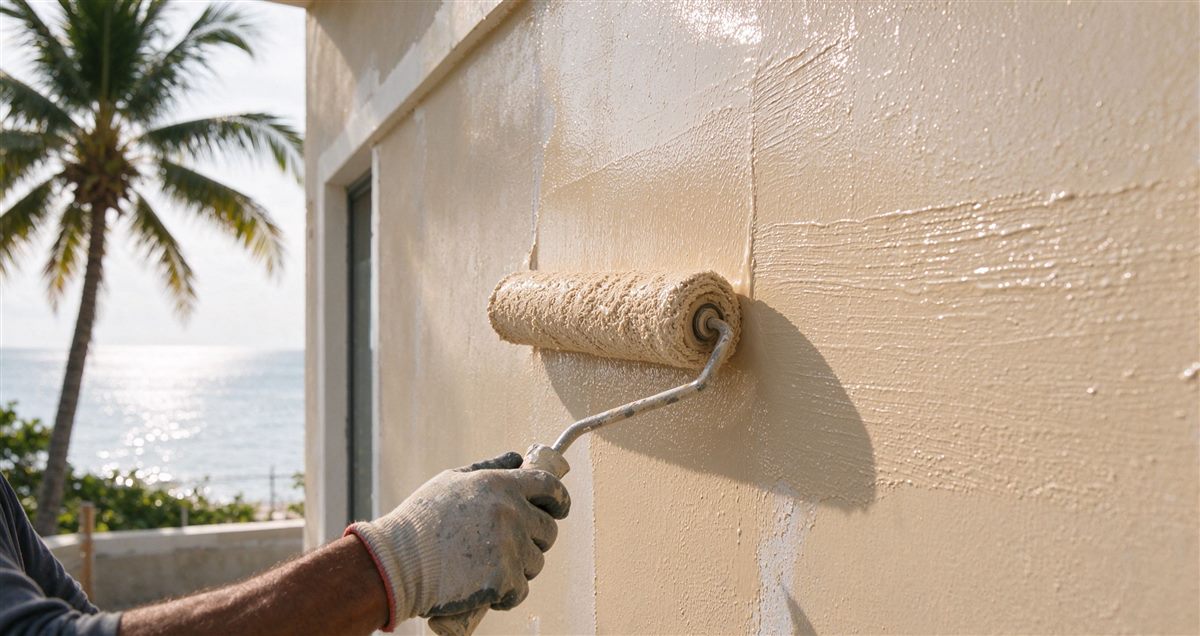
Choosing exterior paint for humid climates
The right topcoat depends on the wall, the exposure and the look the project needs. The table below compares the main options used on coastal buildings in Southeast Asia.
| Coating type | Best for | Watch out for |
|---|---|---|
| Acrylic exterior emulsion | General coastal residential and commercial walls; breathable, colour-stable and widely available | Choose a grade with mildew and dirt resistance; do not use it as a waterproofing layer |
| Silicon-acrylic or fluoropolymer topcoat | Exposed seafront facades, high-rise buildings and projects that need a longer repaint cycle | Higher cost; needs a compatible primer and careful application |
| Elastomeric acrylic coating | Walls with hairline cracks or movement, where a flexible film helps bridge small gaps | Can trap moisture if the wall is damp; not a substitute for fixing leaks or structural cracks |
| Textured or stone-effect coating | Facades where appearance matters and a thicker finish is wanted | Rough surfaces hold dirt in humid air; clean regularly and use a compatible primer |
Ask for the product data sheet and check three things: the recommended substrate condition, the recoat time and the weather limits for application. A coating that performs well in a dry climate may need a different primer or a longer drying window on the coast.
Preparing a coastal wall before painting
Preparation decides more of the result than the brand on the bucket. On a coastal wall, the sequence usually looks like this.
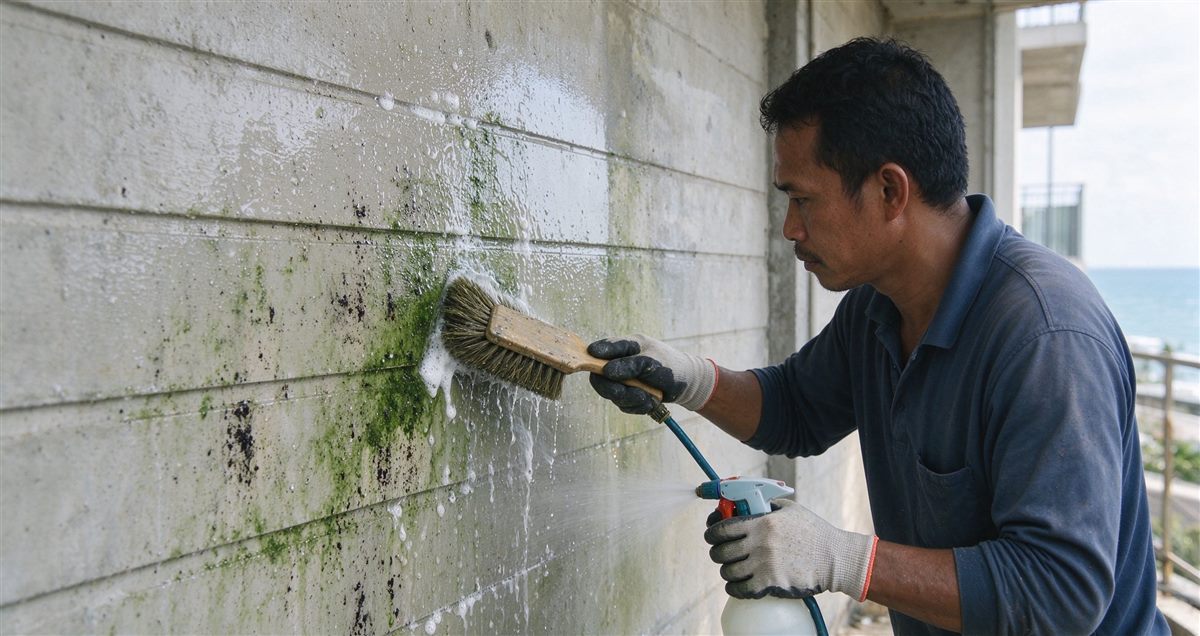
- Wash the wall. Remove salt, dust, pollution and loose chalk with clean water and a stiff brush. On heavy build-up, use a suitable exterior cleaner and rinse thoroughly.
- Treat biological growth. Apply a mould and algae cleaner, leave it to work, then scrub and rinse. Do not dry-scrub mould, because it spreads spores and dust.
- Repair cracks and joints. Cut out failed sealant, refill cracks and replace loose render. Water finds these points first, and paint cannot bridge a moving joint.
- Check moisture. Tape clear plastic to the wall overnight. Condensation or a darker patch means the wall is still releasing moisture. Find the source and let the wall dry before coating.
- Prime bare areas. New concrete, render and repaired patches need an alkali-resistant primer. Spot-prime bare spots on previously painted walls after the loose coating is removed.
If white salt deposits keep returning, the wall still has a water path. Our guide to efflorescence on concrete walls explains how to trace it. For a full sequence from inspection to handover, see the durable exterior wall coating system.
Application around rain, heat and humidity
Coastal weather rarely offers a perfect painting day, so the work has to be planned around the forecast and the product limits.
- Pick a dry window. Do not start if rain is likely before the film can dry. Once rain hits a fresh water-based coating, the damage is difficult to repair without sanding back.
- Watch the wall temperature. A wall in direct afternoon sun can be much hotter than the air. Hot surfaces make the paint dry too fast, which leads to roller marks and poor adhesion. Early morning is often the safest window.
- Respect humidity limits. If the air is too humid or the wall is below the dew point, moisture can condense on the surface. Follow the data sheet and stop when conditions move outside the stated range.
- Do not over-thin. Thinning may help application, but too much water weakens the film and reduces its resistance to salt and rain. Use only the dilution the manufacturer allows.
- Apply two full coats. The first coat seals and builds the base; the second closes pinholes and gives an even film. Cutting corners here is the most common reason a coastal facade fails early.
Maintenance that keeps the facade looking new
A coastal facade does not need much, but it does need attention before problems become visible.
Wash the walls once a year with clean water and a mild exterior detergent. This removes salt and dirt before they build up. Pay attention to the shaded side, the area under eaves and the wall behind plants, where moisture stays longest.
After the monsoon, walk around the building and look for blisters, cracks, green patches and chalky residue on your hand. Touch in small areas before water gets behind the film. Keep gutters, downpipes and drains clear so water runs away from the wall instead of down the facade.
If mould keeps returning in the same place, the cause is usually moisture, not the paint. Our article on mould and algae on exterior walls covers the common sources and how to deal with them.
Frequently asked questions
What is the best exterior paint for salty coastal air?
For most buildings, a breathable acrylic exterior paint over an alkali-resistant primer is the practical choice. On exposed seafront facades, a silicon-acrylic or fluoropolymer topcoat can extend the repaint cycle. The system matters more than a single product name.
How often should I repaint a coastal facade?
There is no fixed interval. A well-applied system on a sheltered wall may last many years, while an exposed wall with salt spray and strong sun will need attention sooner. Inspect once a year and after the rainy season, then repaint when the surface starts to chalk, fade or hold dirt.
Can I paint during the rainy season?
Only in a dry window, and only if the wall and air conditions are within the product limits. Avoid painting when rain is forecast, when the wall is wet or when humidity is too high for the coating to dry properly. Early morning is usually better than late afternoon.
How do I stop mould and algae from coming back?
Remove the moisture source first. Clean the wall thoroughly, kill the growth, repair leaks and improve drainage and ventilation. Then use a topcoat with mildew resistance. Painting over active growth without cleaning will not stop it returning.
Is elastomeric paint better in humid climates?
Only when the wall has hairline cracks or movement that a flexible film can bridge. Elastomeric coatings are not waterproofing and can trap moisture if the wall is damp. Fix leaks and check moisture before using one.
Specifying a coastal system for your project
A coastal facade needs a system, not a single coat. Match the primer to the substrate, choose a topcoat for the exposure, and leave enough time in the programme for proper preparation and drying.
Five Lakes Coatings Chemical Co., Ltd. has produced acrylic emulsions and architectural coatings in Ningjin, Shandong since 1984. The 100-mu factory runs 13 emulsion lines with a capacity of 100,000 tonnes per year and two coating systems with a capacity of 50,000 tonnes per year. The Defwei range includes exterior latex, real stone paint, water-in-water and water-in-sand systems. You can see the full range on our products page or contact our team for a specification recommendation and a sample request.