
A Middle East facade asks more of a coating than a mild-climate facade. The wall can be hot enough to cook an egg in the afternoon, the UV is intense, dust and sand are constant, and the temperature swings between day and night. A coating that looks fine on a sample board can chalk, fade or peel within a season if the system is not chosen for these conditions.
This guide explains what heat, UV and dust do to exterior coatings and how to specify a system that holds its colour and adhesion on a Middle East project.
What makes the Middle East hard on coatings
The region is not one climate, but many projects share the same stresses: strong sun, high surface temperatures, wind-blown dust, sand abrasion, and a large day-night temperature swing. Coastal sites add salt. Inland sites add dust and dry heat. Rain is rare but can be intense when it comes, and construction dust is often present long after the building is finished.
A coating has to stay flexible through the temperature swing, resist UV at the surface, release dust when it is washed and keep its colour. That is a different brief from a mild, wet climate.
Projects also differ. A tower on the coast sees salt and humidity; a low-rise inland site sees more dust and a bigger day-night swing. The same product family can work in both, but the primer, the colour and the maintenance plan should be adjusted to the site rather than copied from another project.
How heat and UV attack a coating
In direct sun, a dark facade can be much hotter than the air. The binder softens, the surface chalks and the pigments fade. Over time the film hardens and loses its stretch, so the next movement in the wall opens small cracks. The damage is cumulative: a wall that looks acceptable after one summer can be brittle after three.
UV also attacks the binder itself, not just the colour. A coating with a weak binder and a strong pigment will still fail, because the resin that holds the film together breaks down first.
Look at existing buildings in the area. A facade that has chalked or faded after a few years is a useful warning about the binder and the colour, not just the age of the building. Ask what system was used and how often it has been cleaned.
Why standard exterior paint fails early
Ordinary exterior paint often fails on these walls for predictable reasons: a cheap binder that chalks quickly, a thin film that cannot hide the substrate, no primer, a dark colour that raises the surface temperature, or application on a wall that was too hot. Fixing any one of these helps, but the system has to be right as a whole.
How dust and sand affect the surface
Dust is not only a cleaning problem. If it is on the wall before priming, the primer bonds to dust rather than concrete, and the whole system can lift later. Wind-blown sand abrades the film, especially on low walls and corners. A textured finish holds more dust than a smooth one, so a dusty site may favour a flatter surface that washes clean.
Dust also matters during application. A site with active sanding, cutting or traffic can put a layer of grit on a fresh coat before it dries. Plan the work and protect the elevation.
Coastal salt behaves like dust in one way: it holds moisture and dirt on the surface. Rinse it off regularly and check fixings and edges, where salt collects first. Inland dust is drier, but it still needs to be removed before coating.
Choosing the binder
For a sun-exposed Middle East facade, a pure acrylic binder is the usual choice. It holds colour better, resists UV longer and stays flexible through the temperature swing. Styrene-acrylic can work on sheltered walls where cost matters, but it tends to chalk faster in intense sun. Vinyl-acetate paints belong indoors.
Pigment quality matters as much as the binder. A UV-stable pigment system holds its colour; a cheap pigment fades even under a good resin. For a premium facade, a clear topcoat can add water resistance and dirt release, but it does not replace a UV-stable base coat.
On a facade with thermal movement, an elastic acrylic system can absorb more movement than a standard paint. It is not a substitute for repairing a structural crack, but it helps on large elevations and repaired walls. A clear topcoat can improve water resistance, but it should be specified as part of the system, not added at the end.
Colour and surface temperature
Light colours reflect more solar radiation and stay cooler. A dark facade can be much hotter than a white one, which speeds up binder degradation and thermal movement. On a hot, dry project, specify light or medium tones where the design allows, and use a higher-performance binder on dark accent areas.
Colour is a design decision, but it is also a durability decision. A dark wall in full sun needs a better system than the same wall in shade.
Coating systems for different facades
| Facade or condition | Recommended system | Notes |
|---|---|---|
| New concrete or render, cured | Alkali-resistant primer + pure acrylic exterior emulsion | Check moisture and pH; two finish coats |
| Large facade with thermal movement | Elastic primer + elastic acrylic topcoat | Repair cracks wider than the bridging limit |
| Dusty site, easy-clean priority | Smooth acrylic finish | Flatter surface releases dust more easily |
| Premium stone look | Primer + real stone paint or water-in-sand | Sample panel; expect more dust in the texture |
| Coastal site | Primer + acrylic system with salt resistance | Rinse salt regularly; check fixing details |
The table is a starting point, not a substitute for the product data sheet. The substrate, the exposure and the maintenance plan decide the final system.
Application in hot, dusty conditions
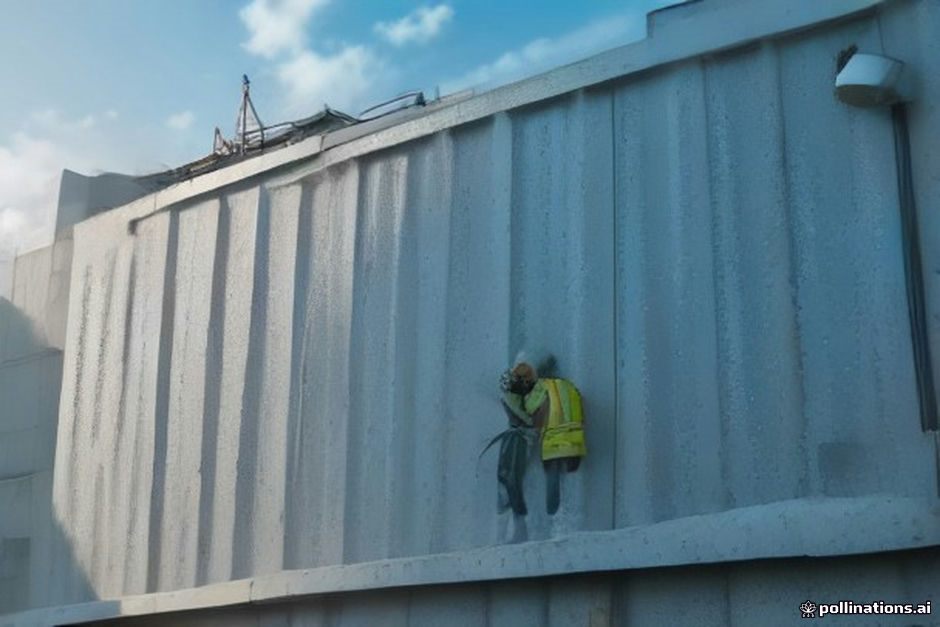
Work early in the morning or shade the elevation. Do not apply to a wall that is too hot to touch; the film can skin over before it has bonded. Build the coating in thin, even passes and keep within the recoat window. Keep dust-generating work away from the fresh wall, and protect the surface from wind-blown sand until it has cured.
A sample panel on site is essential. It shows how the colour and texture behave in the local light and gives the applicator a target for the full elevation.
Plan scaffolding and access around the weather. A hot wall in the afternoon may be too hot to coat, so the work may need to start at dawn and stop before the surface heats up. Keep the same team and the same mix across the elevation so the colour and texture stay consistent.
Maintenance and inspection
Wash the wall when dust builds up, and inspect it after the first hot season. Look for chalking, colour shift, hairline cracks and dull patches. A maintenance coat applied before the film fails is cheaper than a full repair, and it keeps the facade looking consistent.
FAQ
What is the best exterior paint for a hot Middle East climate?
A pure acrylic exterior paint with UV-stable pigments and good alkali resistance is the usual choice. On a facade with thermal movement, an elastic acrylic system may be better. The primer and the preparation matter as much as the topcoat.
How often should a facade be repainted in the Middle East?
It depends on the coating, the colour, the exposure and the substrate. Inspect after the first hot season and plan maintenance before the film fails. A light colour on a good system can last longer than a dark colour on a cheap one.
Does a light colour really make a difference?
Yes. Light colours reflect more solar radiation and stay cooler, which slows binder degradation and thermal movement. Dark colours can be significantly hotter in direct sun.
Can I use real stone paint in a hot, dusty climate?
Yes, if the substrate is sound and the system is specified for the exposure. The texture holds more dust than a flat finish, so plan more frequent cleaning. A sample panel shows how the texture behaves on site.
How do I stop dust from ruining the finish?
Clean the wall before priming, keep dust-generating work away from the fresh coating, and protect the elevation until it cures. On a dusty site, a smooth finish is easier to wash than a deep texture.
Final word
Middle East facades fail early when the coating is chosen for the colour chart rather than the climate. Use a UV-stable binder, a light colour where possible, the right primer and a clean, dust-free application. Then inspect after the first hot season and maintain before the film fails.
Five Lakes Coatings has made water-based coatings since 1984, including exterior wall emulsion paint, alkali-resistant sealing primer and real stone paint. For help specifying a Middle East facade, send us the project details. For a comparison of textured finishes, read water-in-water vs water-in-sand.